


A marketing director searches Google for the best CRM for their growing business. They want to know which platforms are suitable, what they'll cost, whether they'll integrate with existing systems and how difficult migration might be.
That's quite a lot to investigate through one search.
Google's AI search experiences can tackle this problem using query fan-out, a technique that runs multiple related searches to gather information before producing an answer.
For B2B marketers, this has an important implication. Your content could become relevant to a buying decision even when it doesn't directly target the buyer's original search term.
Here's how query fan-out works, what it changes and how to account for it in your content strategy.
What is query fan-out in AI search?
Query fan-out is a technique that allows AI-powered search systems to investigate different aspects of a question through multiple related searches.
Rather than relying exclusively on results for the original query, the system can retrieve information across several subtopics and sources before generating a response.
Google's explanation of query fan-out describes how AI Mode can issue multiple searches simultaneously, gathering information that helps answer more complex questions.
Google also confirms that AI Overviews may use the same technique.
Consider someone researching enterprise software. Answering their question might involve checking product capabilities, pricing, compatibility and customer experiences.
Instead of requiring the user to search for each separately, AI search can investigate related questions and combine the findings.
Not every search involves query fan-out, and Google doesn't publish a complete record of the internal searches generated for individual responses.
For marketers, the practical question is whether their content addresses the different information needs involved in a purchasing decision.
What does query fan-out look like in a B2B buying journey?
Imagine a marketing director at a 40-person UK consultancy searching for:
"What's the best CRM for a growing B2B business?"
The original query is broad. The buying requirements aren't.
The company might need a CRM that integrates with its existing tools, supports sales reporting and doesn't require months of implementation.
An AI search system could investigate related questions such as:
| Buyer consideration | Illustrative related search |
|---|---|
| Suitability | Best CRM platforms for B2B professional services |
| Features | CRM pipeline reporting and automation features |
| Integration | CRM integrations with Microsoft 365 |
| Cost | CRM pricing for a 40-person company |
| Implementation | CRM data migration and setup requirements |
Different sources could help answer each question.
A comparison article might explain which platforms suit professional services firms. Product documentation could establish integration capabilities. A pricing page might clarify subscription costs, while an implementation guide could address migration requirements.
That creates opportunities for several types of content to contribute to a single AI-generated answer.
A detailed CRM migration guide, for example, might be relevant even if it has little visibility for the broad keyword "best B2B CRM".
Why does query fan-out matter for B2B SEO?
Traditional SEO often starts with individual keywords, their search volumes and the pages most likely to rank for them.
That remains useful. Commercial keyword rankings still provide valuable evidence of search visibility.
However, query fan-out means that the information supporting an AI-generated response may come from pages targeting related questions rather than the original search term.
This has two important consequences.
Content gaps can limit your relevance
Suppose a CRM provider has strong product pages but little information about implementation costs, integrations or migration.
It might compete effectively for broad product searches while offering limited answers to the questions buyers ask during a more detailed evaluation.
Those gaps matter whether someone conducts the research manually or uses AI search.
Our September AI and SEO update covered search advertising data showing a shift towards longer, more specific queries.
Although that dataset doesn't directly measure query fan-out, it reinforces the importance of understanding the detail behind customer searches.
Marketers must begin serving content for the agentic discovery phase on behalf of a B2B prospect and it really needs to give all the information to help with decision making or you may not get past the first hurdle. Traditionally companies may have held back pricing information or detailed product specs, those days are likely numbered for marketing teams.
Topic coverage matters alongside individual rankings
A well-developed topic cluster can address different aspects of a subject without forcing everything onto one page.
For a CRM provider, that might mean a core product page supported by integration guides, pricing information, implementation resources and customer case studies.
Each page answers a distinct question and links to related material where useful.
This creates a more complete resource for prospective customers while giving search engines access to information covering different parts of the topic.
The goal isn't to rank hundreds of pages for minor keyword variations. It's to cover the subjects that genuinely influence a purchase.
How should B2B marketers adapt their content strategy?
You don't need to predict every query an AI system might generate.
A more useful approach is to identify the questions buyers actually ask, check whether your website answers them and prioritise the gaps.
Here's how to do it.
1. Collect questions from real buying conversations
Start with your sales and customer-facing teams.
Ask what prospects want to know before requesting a demo, involving procurement or signing a contract.
For a CRM provider, recurring questions might include:
- Can we migrate our existing customer records?
- Does the platform integrate with Microsoft 365?
- How long does implementation usually take?
- Which reporting features are included in each pricing tier?
- What happens if we need to change providers later?
These questions can be more useful than another broad keyword list because they're grounded in purchasing decisions.
Combine them with search data, customer interviews, support enquiries and competitor research.
Look particularly closely at questions that repeatedly delay deals or require lengthy explanations from sales staff.
2. Group questions around buying requirements
Once you've collected the questions, organise them into practical categories.
For B2B software, these might include suitability, functionality, integration, costs, implementation and proof of results.
Then check which questions your website currently answers.
A simple content audit can use three classifications:
- Answered: The information is available, accurate and easy to find.
- Partially answered: The topic is mentioned, but important details are missing.
- Unanswered: Buyers must look elsewhere for the information.
This gives you a more useful starting point than creating pages around every AI-generated suggestion.
Prioritise the gaps that affect commercial decisions, particularly those associated with high-value products or services.
3. Improve existing pages before commissioning new ones
Not every missing answer deserves a standalone article.
A question about supported integrations might belong on an existing product page. A detailed guide to migrating thousands of customer records could justify its own resource.
Review your existing content for opportunities to:
- Expand thin explanations with useful detail.
- Add specific answers to recurring customer questions.
- Update outdated pricing or technical information.
- Consolidate pages covering substantially the same subject.
- Link related guides to the appropriate product or service pages.
Our AI SEO case study demonstrates how pillar pages, supporting content and internal linking can work together within a wider search strategy.
This also reflects the Content stage of our Answer Loop methodology, which organises B2B content around commercially relevant topics and buyer questions.
A focused audit may reveal that improving five existing pages would be more useful than commissioning ten new articles.
4. Make the answers specific and verifiable
Consider two statements about CRM implementation.
"Our CRM is easy to implement and integrates with your existing systems."
And:
"Our CRM supports Microsoft 365 integration. Migration typically involves exporting customer records, mapping existing fields and testing the imported data before switching systems."
The second gives buyers something concrete to evaluate, assuming those details accurately describe the product.
Specificity matters particularly when buyers are comparing suppliers or evaluating potential risks.
Where relevant, support your content with product documentation, implementation steps, genuine customer results and original research.
Be equally clear about limitations. If a feature requires a higher subscription tier or an integration needs custom development, say so.
Precise information helps buyers make decisions and gives AI search systems more useful material to retrieve.
5. Keep supporting content accessible and connected
Query fan-out makes the relationship between your commercial pages, supporting expertise and evidence particularly relevant. A buyer’s question about supplier suitability could lead to research into integration requirements, implementation risks or sector experience.
Your content architecture should reflect those connections. For B2B marketers, that creates four priorities:
Make commercially valuable expertise accessible. Publish substantive answers about capabilities, costs and implementation on accessible web pages. Review information currently confined to gated resources, sales decks or interactive tools.
Give each page enough context to stand alone. Identify the product or service, its intended customer and the circumstances in which the guidance applies. A specialist answer should remain understandable when discovered independently of your main service page.
Connect claims with supporting evidence. Link capability statements to relevant documentation, research and customer examples. Help buyers inspect the basis for your positioning.
Build useful routes through the evaluation. Connect pricing, integration, implementation and comparison content where the next question naturally follows. Give each page a distinct purpose within that journey.
For example, a CRM integration guide should explain the supported connection, subscription requirements and limitations, then link to relevant implementation and pricing information.
Audit a priority buying journey from its commercial page through to the supporting answers. Check whether each answer is accessible, sufficiently contextualised and connected to the evidence a buyer needs to proceed.
How can you measure visibility when one question produces multiple searches?
Marketers can build a useful picture by combining search performance, AI visibility and commercial data.
1. Monitor conventional and AI search performance
Continue tracking organic rankings, clicks and conversions across commercially important topics.
Google also introduced dedicated Generative AI performance reports in Search Console in June 2026.
These reports show impressions within generative AI features and identify which pages appeared, with additional breakdowns by country, device and date where available.
They don't reveal the complete list of internal searches generated through query fan-out.
Use the reports alongside conventional Search Console data to see which subjects and pages are gaining visibility.
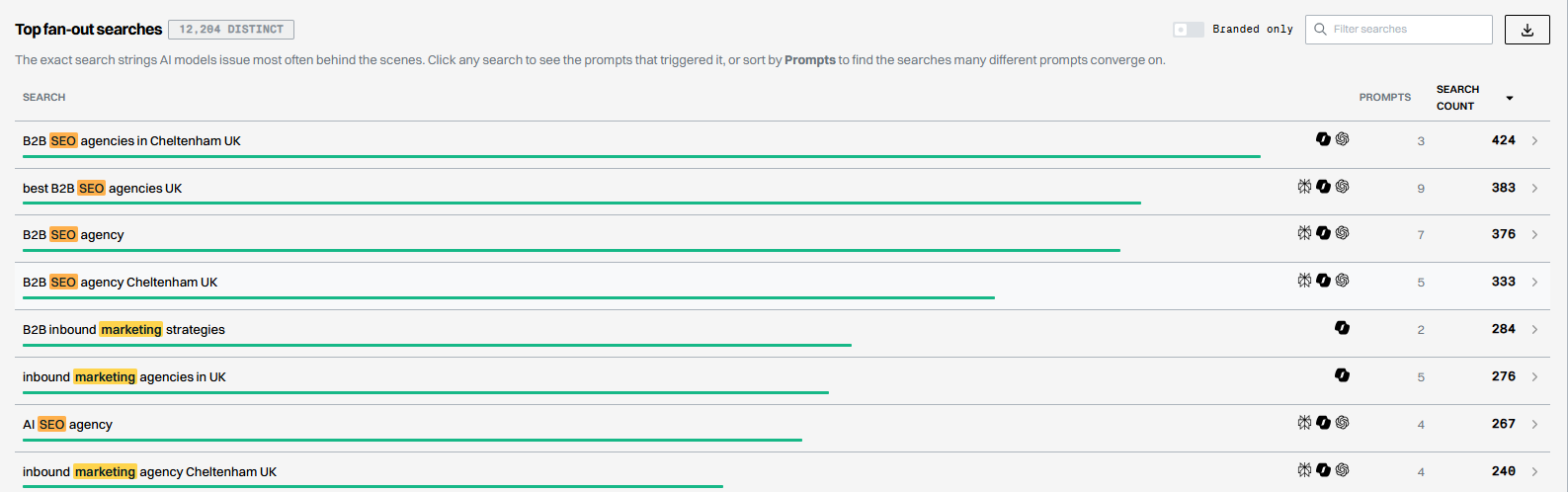
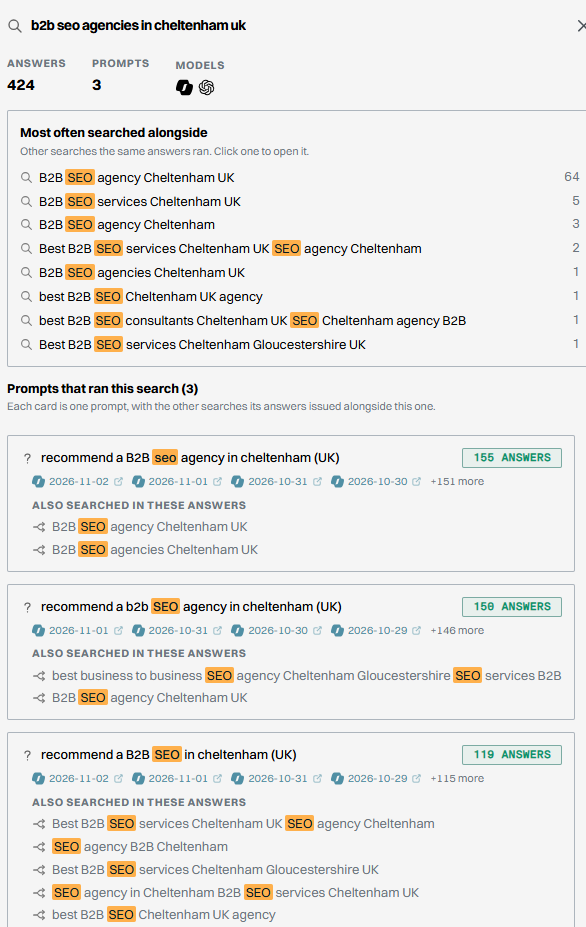
IIn addition, we use specialist tools at Angelfish to help get deeper insight into the query fan outs within a given prompt. Gauge for example helps us to map the fan outs as you can see in this example:
2. Track relevant buyer prompts
Build a consistent set of questions that reflect genuine purchasing decisions.
For the CRM example, these could cover provider recommendations, migration challenges, integrations and pricing.
Test them periodically (ideally daily) across relevant AI search platforms, recording which brands appear and which sources are cited. AI-generated responses can vary, so one result isn't reliable evidence of a lasting visibility change. Using your own model is also challenging due to history, location and memory. Our systems help us to get a more neutral guide on how your brand is doing in key target topics across LLMs.
3. Connect visibility to commercial outcomes
Visibility is only useful if it helps attract the right prospects.
Monitor qualified enquiries, demo requests and opportunities associated with your content. Tracking converting visitors stated source of how they found you really helps, as AI searches can lead to varying journeys and source can sometimes be tricky to pin down. Compare this to source data in GA4 and/or HubSpot along with citation and brand mention mapping within your target prompts.
Follow the pipeline journey in your CRM connected to this source data to enable you to analyse lead, pipeline and deal creation from AI search.
Build content around the buying decision
Query fan-out doesn't require B2B marketers to abandon traditional SEO or create a separate content strategy for AI search.
It does make understanding the wider buying decision more important.
A prospect comparing software providers may need information about features, integration, implementation, costs and risks. Your website should make those answers available, whether the buyer researches them individually or encounters them through an AI-generated response.
Start with the questions your customers actually ask. Audit the content you already have, close the important gaps and measure whether stronger coverage translates into qualified demand.
At Angelfish Marketing, our Answer Loop methodology connects buyer research, topic development, technical SEO and performance measurement within a single search strategy.
Want to identify the questions your content isn't answering? Book a free strategy session to review your current visibility and explore where to focus next.
About the Author: Daniel Elliott-May
AuthorDaniel Elliott-May is an SEO Executive at Angelfish Marketing, specialising in SEO content optimisation, technical and link building.
Connect on LinkedIn