


Discover how Tapadoo, Ireland's leading mobile app development agency, grew AI visibility by +16.4 points across all major LLM platforms in just 90 days — securing the #1 position ahead of every competitor in the category.
By the Numbers
-
+16.4pts AI Visibility Growth in 90 Days
-
#1 Brand Visibility Rank vs All Competitors
-
+9.85pts Domain Citation Rate Increase
-
90 Days from Launch to #1 Position
.png?width=1462&height=477&name=gauge-all-platforms-blurred%20(1).png)
Gauge visibility dashboard — Tapadoo ranked #1 at 47.7% across all AI platforms in the Mobile App Development Agencies category (Dec 1, 2025 – Feb 17, 2026).
Background
Tapadoo is a specialist mobile app development agency based in Ireland, delivering native iOS and Android applications for clients across the UK and Ireland. With a reputation built on technical excellence and long-term client relationships, Tapadoo's challenge was one shared by many established B2B service companies: they were trusted by their clients but increasingly invisible in the AI-driven discovery channels where their next customers were searching.
As decision-makers began asking ChatGPT, Gemini, Google AI Overviews, and Perplexity questions like "recommend an app developer in Ireland" or "best iOS app development agencies", Tapadoo needed to ensure their brand appeared in those answers — not just on page one of Google.
The Opportunity
When we launched Tapadoo's AI SEO programme in December 2025, they sat at 31.3% overall visibility across all major LLM platforms. Our goal was clear: achieve measurable, category-leading growth within 90 days. They had a foundation of quality content and strong domain authority, but their pages weren't optimised for the way AI systems now retrieve, evaluate, and cite sources.
We identified three specific opportunities:
-
Location-specific service pages had untapped citation potential — pages targeting Dublin, Northern Ireland, Limerick, and regional queries were barely being referenced by LLMs.
-
Platform-specific pages (iOS and Android development) needed structural and content improvements to become citation-ready for AI systems.
-
Trust and authority pages (About Us, Development Process) could be optimised to reinforce E-E-A-T signals that LLMs increasingly weight when deciding which brands to recommend.
The Solution
Angelfish Marketing developed a targeted AI SEO strategy focused on increasing Tapadoo's citation rate across all major LLM platforms. Rather than a broad content overhaul, we focused precision optimisation on the pages most likely to be retrieved and cited in response to commercial AI prompts.
Citation-Ready Content Optimisation
Tapadoo has some good foundational content, so were able to restructure key service and location pages to improve how AI systems parse, extract, and reference their content.
This included refining page introductions to lead with clear, factual statements that LLMs can confidently cite, adding structured data and schema markup to help AI systems understand page purpose, and ensuring each page could stand alone as a credible answer to a specific commercial prompt.
Prompt Mapping and Targeting
We identified the high-value commercial prompts driving discovery in the mobile app development category — prompts like:
-
"recommend an app developer in Ireland",
-
"best Android app agencies UK and Ireland",
-
"iOS development companies Dublin"
Each target prompt was mapped to a specific Tapadoo page, and content was refined or a new one created to maximise citation likelihood for those queries.
Authority Building Through Targeted Editorial Outreach
To accelerate the authority signals that both Google and LLMs rely on, we ran a focused link-building campaign targeting high-value B2B editors and journalists at business blogs, technology publications, and online industry directories. Rather than pursuing volume, we prioritised editorial placements in the publications that AI systems already reference and trust — ensuring each backlink carried maximum weight for both traditional domain authority and LLM citation likelihood.
This editorial outreach worked hand-in-hand with the pillar content strategy. High-quality pillar pages gave editors something genuinely worth linking to, while the resulting backlinks from trusted publications reinforced the topical authority signals that drive AI citation. The compounding effect was significant: as domain authority grew, LLMs became increasingly confident in recommending Tapadoo — which in turn attracted further editorial attention and organic backlinks.
Cross-Platform Monitoring
Using prompt tracking tools, we tracked visibility and citation performance across ChatGPT, Google AI Overviews, Gemini, and Perplexity — allowing us to see which platforms were responding to our optimisations and where further work was needed.
Pillar Pages, Topic Clusters, and Authority Architecture
Underpinning the entire strategy was a structured content architecture built around pillar pages and topic clusters — a methodology that serves as the beating heart of sustainable AI visibility.
The process began with commercial keyword research. We identified the high-intent search terms that Tapadoo's ideal clients were using — both in traditional Google search and in conversational AI prompts. These weren't generic informational queries; they were the terms that signal genuine buying intent, such as "mobile app development cost Ireland", "how to choose an app developer", and "native vs cross-platform app development."
From this research, we built comprehensive pillar pages — authoritative, in-depth resources that became the definitive answer for each core topic. Each pillar page sits at the centre of a topic cluster: a network of supporting blog posts and content pieces that link back to the pillar, reinforcing its authority and expanding the surface area of queries it can be cited for.
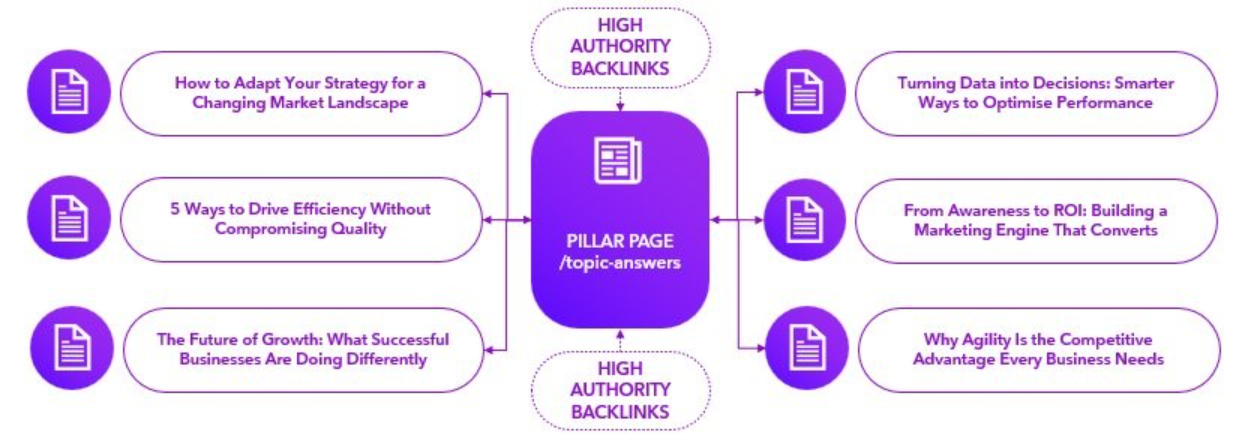 Topic cluster methodology — pillar pages act as the central authority hub, supported by targeted content pieces and high-authority backlinks that compound topical authority over time.
This architecture delivers compounding benefits across both Google and AI search simultaneously:
-
Topical authority for LLMs: AI systems evaluate whether a brand has depth and breadth of expertise on a subject before citing it. A single page can rank; a topic cluster signals genuine authority. When ChatGPT or Gemini encounters a web of interconnected, high-quality content covering every angle of mobile app development, it has far more confidence recommending Tapadoo as a trusted source.
-
Citation surface area: Each piece of supporting content creates an additional opportunity to be cited. A pillar page might be cited for the core question, but a supporting article on "app development costs" or "choosing between iOS and Android" captures citations for adjacent prompts — expanding the total number of AI conversations where Tapadoo appears.
-
Google ranking and AI Overviews: The same topical authority that earns LLM citations also strengthens Google rankings. Pages with deep cluster support consistently outperform isolated pages in both traditional organic results and Google's AI Overviews — which is reflected in Tapadoo's +32.3 point AI Overview growth.
High-authority backlinks through targeted editorial outreach: Alongside the organic link attraction that comes from comprehensive pillar content, we ran a focused campaign targeting high-value B2B editors at business blogs, technology publications, and online industry directories. By securing editorial placements and contributor features in publications that LLMs already trust as sources, we accelerated domain authority growth and directly increased the likelihood of AI citation — creating a virtuous cycle between earned media, traditional SEO signals, and AI discoverability. -
Commercial intent alignment: Because the entire cluster is built from commercial keyword research, every piece of content maps to a real search behaviour with genuine buying intent. This isn't content for content's sake — it's a precision-targeted authority build designed to ensure Tapadoo appears in the conversations that lead directly to new business enquiries.
-
The result: Tapadoo's content infrastructure now functions as an AI-ready authority engine. Each new piece of content strengthens the entire cluster, increases citation surface area, and compounds the visibility gains across every AI platform — making the growth sustainable and self-reinforcing over time. In Tapadoo's case, this methodology delivered category-leading results within just 90 days of launch.
The Results
Overall Visibility: All Platforms
Within 90 days of launch, Tapadoo's overall AI visibility grew from 31.3% to 47.7% — a +16.4 point increase — securing the #1 brand position in the Mobile App Development Agencies category, ahead of the competition.
To confirm this wasn't a one-day spike, we compared weekly averages. The first week of December averaged 32.25%, while the final week of February averaged 46.28% — a sustained +14.03 point lift.
All Platforms — Tapadoo #1 at 47.7% visibility (+16.4 pts)
ChatGPT Performance
On ChatGPT specifically, Tapadoo grew from approximately 40% to 52.5% — a +12.1 point increase.
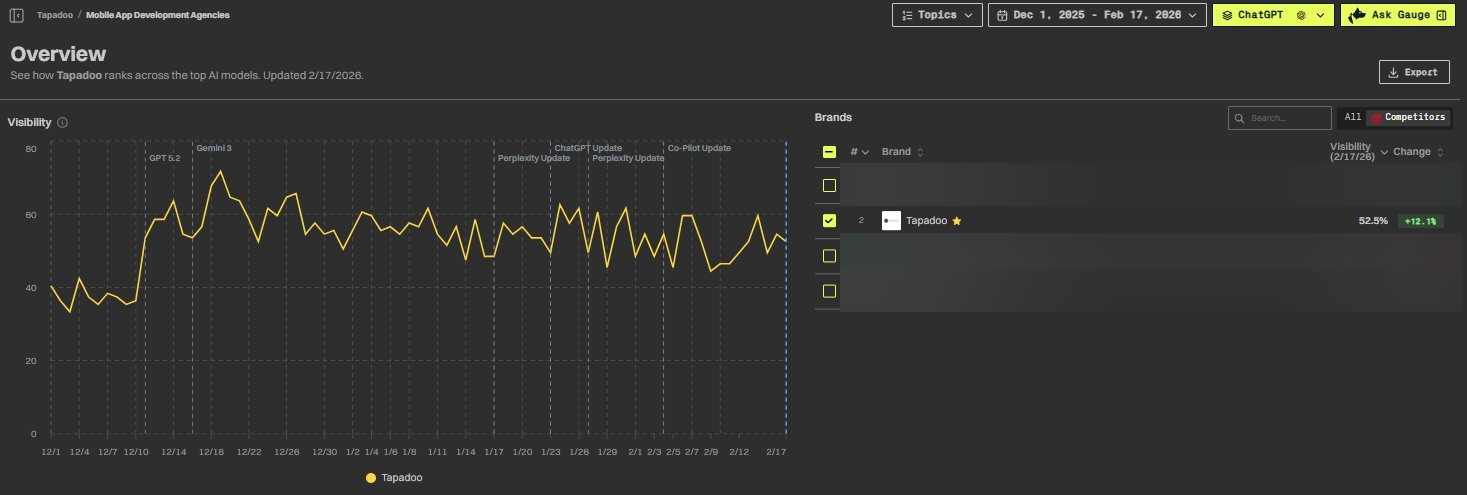
ChatGPT — Tapadoo #2 at 52.5% (+12.1 pts), with significant growth closing the gap on the category leader.
Google AI Overviews
The most dramatic gains came from Google AI Overviews, where Tapadoo achieved a remarkable +32.3 point increase. This is particularly significant given that AI Overviews appear directly within Google search results, reaching users at the exact moment of commercial intent.

Google AI Overviews — Tapadoo #1 at 59.0% (+32.3 pts), the strongest single-platform growth across the campaign.
Gemini
On Google's Gemini platform, Tapadoo secured the #1 position at 68.7% — up +23.2 points. This dominant performance across Google's AI ecosystem (both AI Overviews and Gemini) reflects the compounding effect of strong E-E-A-T signals and well-structured, citation-ready content.

Gemini — Tapadoo #1 at 68.7% (+23.2 pts), dominating Google's AI ecosystem alongside AI Overviews.
What Drove the Lift: Citation Performance by Page
The visibility gains were directly attributable to increased citation rates on Tapadoo's key service, location pages and newly created pillars. The domain-level citation rate grew from 16.2% to 26.0% — a +9.85 point increase.
|
Page |
Citation Change |
Current Rate |
Note |
|
/app-developers-ireland |
+7.07 pts |
17.17% |
Primary service page — largest single driver |
|
/android-app-developers-ireland |
+4.29 pts |
6.57% |
Platform-specific targeting |
|
/ios-app-developers-ireland |
+3.54 pts |
5.30% |
Platform-specific targeting |
|
/app-developers-northern-ireland |
+3.28 pts |
3.28% |
Previously uncited New |
|
/app-developers-limerick |
+2.53 pts |
2.53% |
Previously uncited New |
|
/about-us |
+2.02 pts |
3.79% |
Trust & authority signal |
|
/app-development-process |
+1.77 pts |
2.02% |
Process transparency page |
Key takeaway: The visibility lift was concentrated in location-specific and platform-specific service pages — exactly the pages that map to high-intent commercial prompts. Two pages that had never been cited by any AI system began earning citations for the first time, demonstrating that targeted AEO optimisation can unlock entirely new discovery channels.
Platform-by-Platform Summary
|
Platform |
Visibility (Feb 2026) |
Change |
Rank |
|
All Platforms |
47.7% |
+16.4 pts |
#1 |
|
ChatGPT |
52.5% |
+12.1 pts |
#2 |
|
Google AI Overviews |
59.0% |
+32.3 pts |
#1 |
|
Gemini |
68.7% |
+23.2 pts |
#1 |
Why This Matters
The shift toward AI-powered discovery is accelerating. Research shows that LLM-referred traffic converts at significantly higher rates than traditional organic search — in some studies, the highest-converting channel of any traffic source. For Tapadoo, achieving the #1 visibility position within just 90 days of launch means their brand is now the one being recommended when decision-makers ask AI systems for help finding a mobile app developer.
This isn't passive brand awareness. It's active recommendation at the moment of highest commercial intent — and it's measurable, trackable, and improvable through the kind of targeted AEO strategy we deployed here.
About the Author: Dom Moriarty
AuthorDom Moriarty, Author at Angelfish Marketing
Connect on LinkedIn