


Mentions vs Citations in AI Search: One Is the Prize, the Other Is How You Win It
Two words decide how visible your brand is in AI search, and they are not interchangeable. A mention is your brand being named in the AI's answer: the outcome your buyer actually reads, and — for the commercial prompts that drive enquiries — the thing you are ultimately trying to win. A citation is a source the AI drew on to build that answer: the reference underneath. Understanding how the two connect is the practical heart of answer engine optimisation: you win the mention by influencing the sources the answer is built from.
Key takeaways
- Brand mention = you are named in the answer. For your core commercial prompts, this is the objective.
- Brand citation = your site is one of the sources behind the answer. The citation surface is the route in.
- Map the sources behind the answers for your priority prompts, then build presence across them — on-site and off-site.
What is the difference between a brand mention and a citation?
A mention is when AI names your brand in its answer. A citation is when a specific page — yours or someone else's — is one of the sources AI drew on to build that answer: the reference underneath. Mentions are the visible outcome your buyer reads; citations are the material AI reached for to write it. Every answer is assembled from a set of sources, and that set — the citation surface for that prompt — is where your influence actually lives.
Which matters more — being mentioned or being cited?
For most B2B brands, the mention is the commercial prize. When a buyer asks an AI tool “best [your category] for [your buyer's situation]”, being named in that answer is what shapes the shortlist. But you cannot edit an AI answer directly. The only way to influence what it says is to influence what it reads — and that is the citation layer. So the honest framing is not that one metric beats the other: mention presence is the outcome you are aiming at, and the citation surface is the lever you pull to get there.
One caveat on the numbers you may have seen quoted, including in our own research. Statistics like “brands are named in 92–99% of relevant answers” come from studies of major, established platforms — household SaaS names — measured across largely informational prompts, where coverage of those brands is enormous. If you are a small or mid-sized business, your starting point is usually the opposite: for the commercial prompts that actually drive enquiries, you may not be in the answer at all. That is not a reason for discouragement; it is the actual job description. The task is to put your brand into those answers — and the route runs through the sources AI reads.
How do you get into the answer?
Three steps, in order:
- Identify your core commercial prompts. List the 10–20 prompts a real buyer would ask in your category — “best X for Y”, “X vs Y”, “how to choose a Z provider” — and run them across ChatGPT, Perplexity, Gemini and Google AI Overviews. Note who is named, and which sources each answer cites.
- Map who and what the answers are built from. The cited sources are the citation surface for that prompt: typically a mix of review platforms, comparison articles, communities, trade press and some brands’ own pages. The make-up varies by query — which is exactly why you map it rather than guess.
- Build presence across that surface, on-site and off-site. On-site: create genuinely citable content — original data, clear frameworks, direct answers to the questions in your prompts. Off-site: earn a place in the third-party sources that dominate the surface — review platforms you can manage directly, communities where useful participation compounds, and trade press reached through digital PR — wherever access is realistic for your brand.
What should you measure?
Both layers, because they do different jobs. Track your answer presence — how often your brand is named in the answers to your priority commercial prompts — as the outcome metric. Alongside it, track your citation footprint: how often your own site appears as a cited source, and how present you are across the third-party sources each answer draws on. For an established brand the on-site figure can reach roughly a third of answers; for a growing brand, movement from zero — first citations, first mentions — is the progress that matters. Measuring mentions alone tells you the score without telling you how to change it; measuring the citation layer alone tells you the mechanics without the commercial outcome. You need the pair.
For our clients we help with visibility using advanced AI tracking tools. We track daily brand mentions along with citations (with and without brand presence) that make up the answers in the prompts that are important the brands we're working with. You can see in here an example of a tracked prompt for 'who are the best B2B SEO Agencies in the UK?' and our brand mention. You can then see some of the citations, both on site and off site, that we are currently featured in that were used to make up the answer.
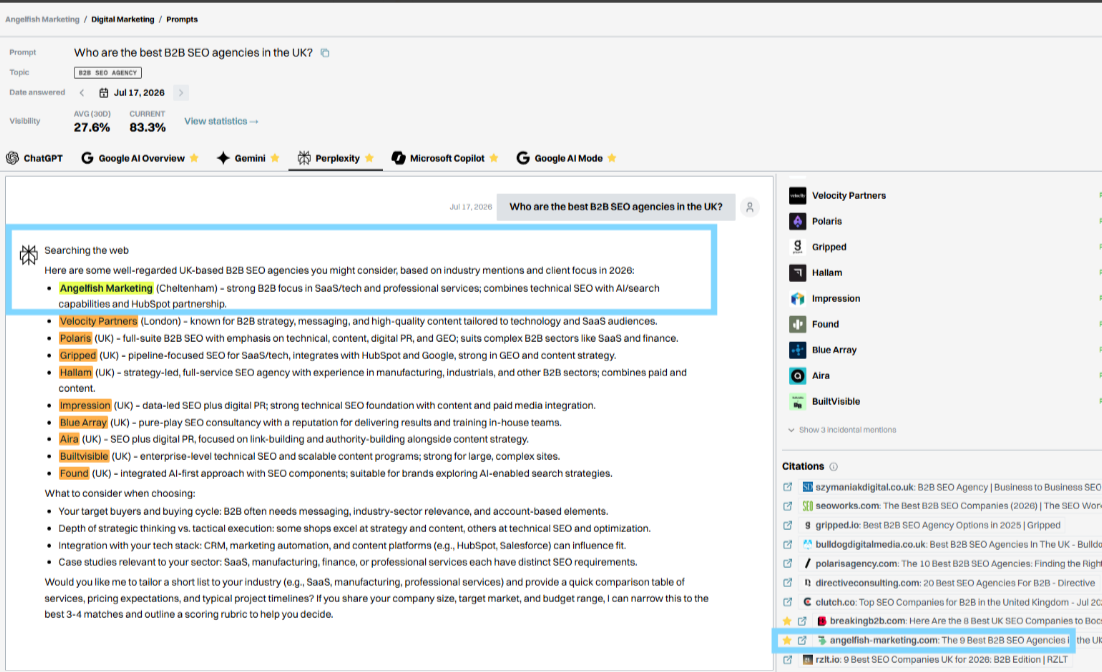
For most of our clients we track 100 core commercially valuable B2B prompts daily across all major LLMs.
What to do this quarter
- List your core commercial prompts and record who is named — and what is cited — in each answer today.
- Pick the two prompts with the clearest revenue link and map their citation surface source by source.
- Rewrite one page into genuinely citable material — original, specific, useful — aimed at those prompts.
- Secure the off-site placements you can realistically access first: complete review-platform profiles, one community contribution, one digital-PR pitch.
These are the outcomes in brief. The full study — 1,052,053 citations across six B2B SaaS brands — breaks down exactly what AI answers are built from and the 42 sources that matter: the B2B SaaS AEO Study.
Want to know which answers your brand is missing from — and what they are built from? Book an AI search audit.
Frequently Asked Questions
What is the difference between an AI brand mention and a citation?
A mention is when AI names your brand in an answer. A citation is when a page is one of the sources AI used to build that answer. Mentions are the outcome buyers see; citations are the material the answer is made from.
Can a small business realistically get into AI answers?
Yes — but rarely by accident. Unlike major platforms, smaller brands usually start outside the answer for commercial prompts. The route in is deliberate: map the sources the answers are built from, then build citable content on-site and earned presence across those third-party sources.
Should I track mentions or citations?
Both, for different reasons. Answer presence for your priority prompts is the commercial outcome; your footprint across the citation surface — own-site citations plus presence on the third-party sources AI reads — is the lever that changes it.
About the Author: Richard Stephens
AuthorRichard is the director and co–founder of Angelfish Marketing, a digital marketing agency specialising in inbound marketing for B2B SME’s.
Connect on LinkedIn